

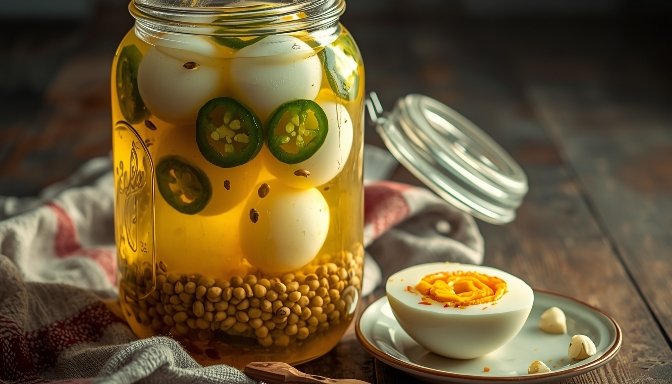
My grandfather kept a glass jar of pickled eggs on his kitchen counter for my entire childhood. The brine was cloudy, the eggs were stained a pale pinkish-yellow from jalapeño juice, and he’d pull one out with a fork whenever he felt like it — breakfast, lunch, or late at night. No sugar. Never any sugar. Just vinegar, salt, peppers, and time.
That jar is the reason I’m writing this.

Pickled eggs are one of those foods that people either grew up with or discovered at a dive bar or a county fair. They’re shelf-stable (refrigerated), they get better as they sit, and they’re nearly impossible to mess up if you follow a few basic rules. The old fashioned version — the one from before people started adding sugar to everything — is simple, sharp, spicy, and deeply satisfying.

This recipe skips the sugar entirely. It’s just eggs, vinegar, jalapeños, salt, and a handful of aromatics. It tastes like something your grandparents might have made, and it takes about twenty minutes of active work to get a jar going.
Why No Sugar?
Sweet pickled eggs exist. Some people like them. But the old fashioned bar-style pickled egg — the kind you’d find in a dusty jar on a counter in Texas, Louisiana, or parts of the Midwest — wasn’t sweet. It was sour, salty, and spicy. The vinegar did the preserving. The peppers did the flavor. Sugar wasn’t part of the equation.
Adding sugar to pickled eggs changes the texture slightly (makes them firmer, almost rubbery) and shifts the flavor profile toward something closer to bread and butter pickles. That’s fine if that’s what you want. But a traditional jalapeño pickled egg should taste like the brine it sat in — bright, sharp, with a kick that builds as you eat.
A bartender I knew in Houston kept a five-gallon bucket of these under the counter. He said the recipe came from his grandmother, and the only written instruction was “no sugar, ever.” I’ve made them both ways. He was right.
Ingredients
This recipe fills one quart-sized jar — about 8 to 10 eggs, depending on how tightly you pack them.
The Eggs
- 8 to 10 large eggs (farm fresh or grocery store, both work)
The Brine
- 1½ cups white distilled vinegar (5% acidity)
- ½ cup water
- 1 tablespoon pickling salt or kosher salt (not table salt with iodine — it makes the brine cloudy and can affect flavor)
The Peppers and Aromatics
- 4 to 6 fresh jalapeños, sliced into rings (seeds in for heat, seeds out for milder)
- 4 garlic cloves, smashed with the side of a knife
- ½ small white onion, sliced thin (optional but traditional)
- 1 teaspoon black peppercorns
- 1 teaspoon mustard seeds
- 1 bay leaf
- Pinch of dried oregano (about ¼ teaspoon)
That’s it. No sugar. No artificial color. No weird preservatives.
Optional Heat Adjustments
- For more heat: add 2 to 3 dried arbol chiles or a teaspoon of red pepper flakes
- For less heat: remove the seeds and membranes from the jalapeños before slicing
Equipment
- 1 quart-sized glass jar with a lid (Mason jar works perfectly)
- Medium saucepan (non-reactive — stainless steel or enameled, not aluminum)
- Slotted spoon or tongs
- Bowl of ice water (for cooling eggs)
The Recipe: Step by Step
Step 1: Hard Boil the Eggs
There are about forty different methods for hard boiling eggs. This one works consistently.
Place the eggs in a single layer in a saucepan. Cover with cold water by about an inch. Bring to a rolling boil over high heat.
Once boiling, turn off the heat entirely. Cover the pot with a lid and let it sit for 12 minutes.
After 12 minutes, transfer the eggs immediately to a bowl of ice water. Let them cool for at least 10 minutes.
The ice water stops the cooking process and makes the eggs easier to peel. Old eggs peel more easily than fresh ones — if you have eggs that have been in the fridge for a week or two, use those.
Peel the eggs carefully. Rinse them under cold water to remove any tiny shell fragments. Set aside.
Step 2: Prepare the Jar
Wash your quart jar and lid thoroughly with hot soapy water. Rinse well. You don’t need to sterilize it for pickled eggs (the vinegar brine is very acidic and will prevent spoilage), but it should be clean.
Pack the peeled eggs into the jar. Don’t force them — they should fit snugly but not be crushed. Arrange the jalapeño slices, garlic cloves, and onion slices throughout the jar as you go, tucking some between the eggs. This distributes the flavor evenly.
Add the peppercorns, mustard seeds, bay leaf, and oregano to the jar. They’ll float around, and that’s fine.
Step 3: Make the Brine
In a non-reactive saucepan, combine the vinegar, water, and salt. Bring to a boil over medium-high heat, stirring to dissolve the salt. Once it boils, remove it from the heat immediately. You don’t need to simmer it — just a quick boil to dissolve everything.
Let the brine cool for about 5 minutes. You want it hot but not boiling when it hits the eggs. Boiling brine poured directly onto eggs can make them rubbery.
Step 4: Pour and Seal
Pour the hot brine over the eggs in the jar, making sure everything is fully submerged. Use the back of a spoon or a chopstick to gently poke around and release any air bubbles trapped between the eggs.
The brine should cover the eggs completely. If it doesn’t, top it off with a little extra vinegar and water in the same ratio (3 parts vinegar to 1 part water).
Wipe the rim of the jar clean. Screw on the lid tightly.
Step 5: Refrigerate and Wait
This is the hardest part.
Let the jar cool to room temperature on the counter — about an hour. Then transfer it to the refrigerator.
Do not open the jar for at least 5 days. A week is better. Ten days is ideal.
The eggs need time to absorb the brine. After 24 hours, they’ll taste like eggs with a little vinegar. After 5 days, they’ll taste like pickled eggs. After 10 days, the jalapeño heat has penetrated all the way to the center, and the yolks have taken on a slight firmness and a pale golden-green color from the peppers.
A friend of mine in Oklahoma marks the date on the lid with a Sharpie so she doesn’t open them early. She says the ones that sit for two weeks are always the best.
The Brine Chemistry (Briefly)
The vinegar does the preserving. The acidity level — 5% acetic acid in standard white vinegar — is high enough to prevent harmful bacteria from growing when the eggs are kept refrigerated. That’s why you don’t need sugar or other preservatives.
Salt adds flavor and also creates an environment where lactobacillus (the good bacteria in fermentation) can’t outcompete the acidity. It’s not strictly necessary for preservation in a vinegar brine, but pickled eggs without salt taste flat and wrong.
The water dilutes the vinegar just enough so the brine isn’t overwhelmingly sour. The ratio here (3 parts vinegar to 1 part water) is the sweet spot — sharp but not punishing.
Authority link placement suggestion: Under this section, a reference to the Wikipedia article on Pickling provides authoritative background on the chemistry of vinegar-based preservation, acidity levels, and food safety considerations. This is useful for readers who want to understand why the recipe works beyond just following instructions.
Jalapeño Choices: Fresh vs. Pickled
Use fresh jalapeños for this recipe. Canned or jarred pickled jalapeños have already been cooked and softened — they’ll turn mushy in the brine and won’t contribute the same bright, grassy heat.
Fresh jalapeños vary significantly in heat level. Grocery store jalapeños are usually milder. Farmers market or homegrown jalapeños can be surprisingly hot. If you’re unsure, taste a small piece of one before you start. If it’s too mild, add an extra pepper or keep the seeds in. If it’s hotter than expected, remove the seeds and membranes from half of them.
The white pith inside the jalapeño — the placental tissue that holds the seeds — contains most of the capsaicin. Removing it drastically reduces heat. Leaving it in keeps the fire.
Adjusting the Recipe
Making It Milder
Remove the seeds and white membranes from all the jalapeños before slicing. Reduce the number of peppers to 2 or 3. Omit the black peppercorns (they add a mild heat of their own). The eggs will still have some kick from the vinegar and garlic, but they won’t be spicy.
Making It Hotter
Add 2 to 3 dried arbol chiles to the jar along with the fresh jalapeños. Arbols are small, thin, and extremely hot — start with one and work up. Alternatively, add a teaspoon of red pepper flakes or a halved habanero (remove it after a week if it becomes too intense).
A cook in San Antonio adds a whole serrano pepper to each quart jar, left intact so it doesn’t release all its heat at once. She fishes it out before serving the eggs to guests who don’t want the full experience.
Adding Other Vegetables
Pickled eggs are excellent with other vegetables in the jar. Try adding:
- Sliced carrots (they turn bright orange and stay crunchy)
- Cauliflower florets
- Green beans (blanch them first for 2 minutes)
- Sliced red onion (it turns the brine a beautiful pink color)
These vegetables pickle at the same rate as the eggs and make the jar look more substantial.
Using Different Vinegars
White distilled vinegar is traditional because it’s clear, clean, and doesn’t add competing flavors. But you can experiment.
Apple cider vinegar produces a slightly fruitier, milder pickled egg. The brine turns amber, and the eggs take on a warm golden color. It’s less sharp and some people prefer it.
White wine vinegar is a good middle ground — slightly more complex than distilled but still neutral.
Do not use balsamic or malt vinegar. They’re too strong and will make the eggs taste strange.
How Long Do Pickled Eggs Last?
Properly refrigerated in a vinegar brine, pickled eggs last for 3 to 4 months. The flavor peaks around day 10 and holds steady for about 6 weeks. After that, the texture starts to change — the egg whites become slightly firmer and more rubbery. They’re still safe to eat, just less pleasant.
Never leave pickled eggs at room temperature for more than a few hours. The vinegar preserves them, but they’re not shelf-stable the way commercial pickled eggs sometimes are (those have been heat-processed). Keep them in the fridge.
If you see any of the following, throw the whole batch away:
- Slimy or mushy eggs
- Foul or rotten smell (the brine should smell like vinegar and peppers)
- Mold on the surface of the brine (white or colored fuzz)
- Bubbles rising from the eggs (indicates fermentation, which shouldn’t happen in a vinegar brine)
These problems are rare if you use clean equipment and keep the eggs submerged. I’ve made hundreds of jars and never lost a batch.
Authority link placement suggestion: Under this section, a reference to the Wikipedia article on Food preservation provides authoritative context on safety, spoilage indicators, and the science behind why pickling works as a preservation method. This helps readers understand the “why” behind the safety rules.
Common Mistakes Worth Avoiding
Using Iodized Table Salt
Iodized salt contains additives that can turn the brine cloudy and leave a slight metallic aftertaste. Pickling salt or kosher salt is the right choice. They dissolve cleanly and don’t affect the flavor.
Slicing the Jalapeños Too Thick
Thick slices of jalapeño don’t release their flavor into the brine as effectively. Aim for rings about ⅛ to ¼ inch thick. A mandoline makes quick work of this, but a sharp knife and steady hand work fine.
Opening the Jar Too Early
Pickled eggs need time. Opening the jar at day two and eating an egg will disappoint you — it’ll taste like a hard boiled egg with a little vinegar on the outside and nothing on the inside. The waiting period isn’t optional. Mark the date on the lid and forget about them for a week.
Not Submerging the Eggs
Any part of an egg exposed to air above the brine can spoil. Make sure the liquid covers everything. If eggs float (they sometimes do), weigh them down with a small, clean glass weight or a slice of onion tucked on top. You can also turn the jar upside down for a few minutes each day for the first week — the eggs will absorb brine from all sides.
Reusing the Brine Improperly
You can reuse pickling brine once, maybe twice, but each use extracts flavor from the brine and reduces its acidity. If you reuse brine, bring it to a full boil for 5 minutes before pouring it over fresh eggs. And add a little fresh vinegar and salt to bring back the strength. After two uses, start fresh.
Serving Pickled Eggs
Pickled eggs are versatile in a way that surprises people who haven’t eaten many of them.
On their own: Straight from the jar, cold, with a sprinkle of salt. This is the classic bar snack.
Chopped into egg salad: Dice pickled eggs and mix with mayonnaise, celery, and a little mustard. The pickled flavor carries through and makes an egg salad that’s far more interesting than the plain version.
On a salad: Slice them into wedges and toss onto a green salad with avocado, tomato, and cilantro. They work as a replacement for hard boiled eggs in almost any salad.
With beer: Pickled eggs and a cold lager or pilsner is a genuinely excellent combination. The acidity cuts through the richness of the beer, and the heat builds between sips.
Deviled pickled eggs: Cut the pickled eggs in half, remove the yolks, mash them with mayonnaise, mustard, and a little of the brine, then pipe back into the whites. The result is a deviled egg with built-in tang and spice. These disappear fast at parties.
Quick Reference Card
Active time: 20 minutes
Wait time: 5 to 10 days
Yield: 8 to 10 eggs (1 quart jar)
Ingredients at a glance:
8–10 hard boiled eggs · 1½ cups white vinegar · ½ cup water · 1 tbsp pickling salt · 4–6 fresh jalapeños · 4 garlic cloves · ½ white onion (optional) · 1 tsp black peppercorns · 1 tsp mustard seeds · 1 bay leaf · Pinch oregano
The non-negotiables:
No sugar. No iodized salt. Keep eggs submerged. Refrigerate. Wait at least 5 days before eating.